The Simple Math Problem Almost Everyone Gets Wrong
A bit of high school math help with a twist: the Monty Hall problem explained simply, why switching doors doubles your odds, and what it teaches about…
A bit of high school math help with a twist: the Monty Hall problem explained simply, why switching doors doubles your odds, and what it teaches about trusting your gut.
Introduction

Here’s a puzzle that has confused mathematicians, professors, and entire internet comment sections for decades, and one we like to use as a fun bit of high school math help with our own students. Even people with PhDs have argued about the answer, sometimes in print, sometimes rather loudly. See if you can spot where your gut instinct leads you astray, and don’t feel bad if it does. Almost everyone’s does at first.
The Setup
You’re on a game show facing three doors. One hides a car, two hide goats. You pick a door, then the host opens a different door to reveal a goat and asks if you want to switch.
Most people’s first reaction is that it no longer matters, two doors are left, so it must be 50/50. That instinct feels obvious. It’s also wrong, and it’s wrong in a way that even mathematicians and university professors have argued about publicly, sometimes refusing to accept the correct answer until they saw it proven out with actual numbers.
Your Gut Says 50/50. Your Gut Is Wrong.
Switching doors actually wins about two-thirds of the time. Staying wins only one-third.
This is known as the Monty Hall problem, and it’s one of the most famous examples of how our brains misjudge probability once new information gets revealed. It’s named after the host of an old game show, and it’s been confusing people since the 1970s for the same reason it still confuses people now: the math and the gut feeling point in completely different directions.
Why Switching Actually Works
The host knows where the car is and always reveals a goat, which quietly shifts the odds in your favor if you switch.
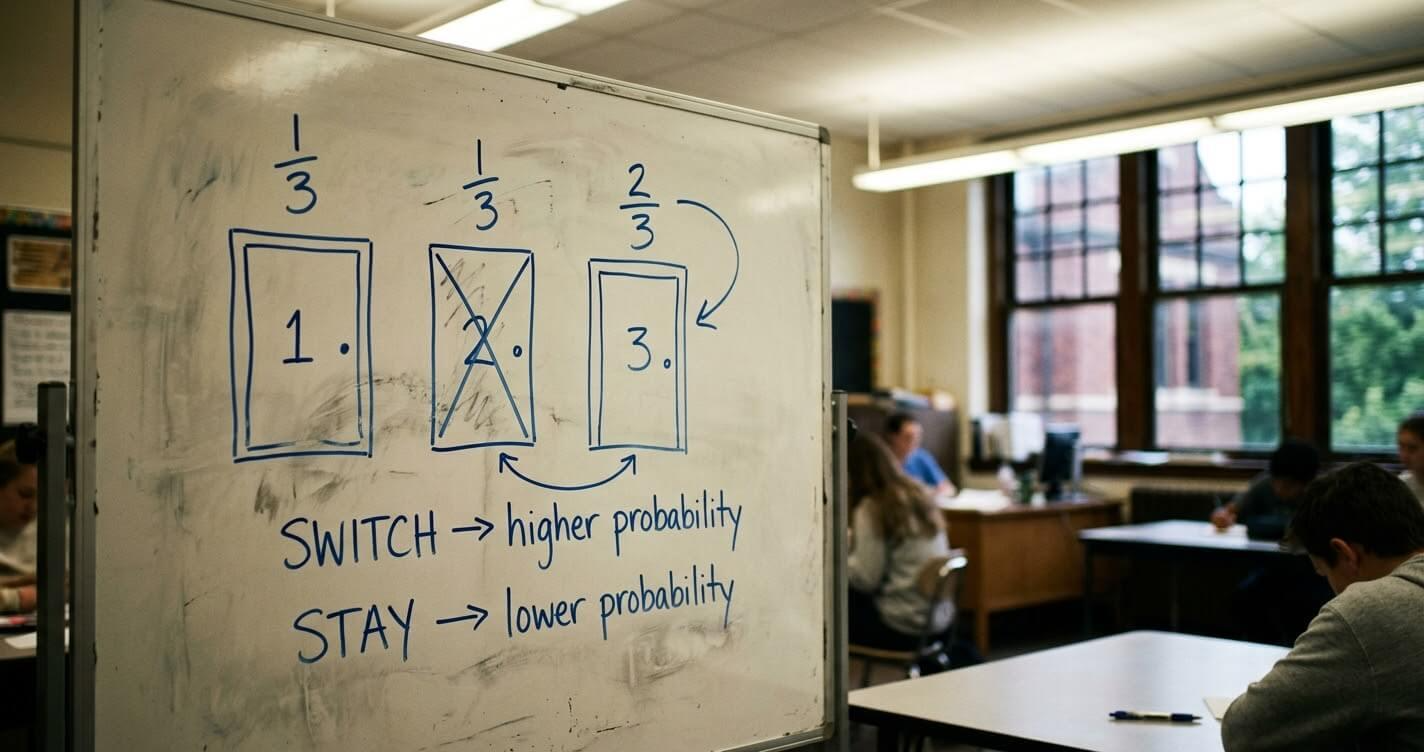
Your first pick had a 1-in-3 chance of being right, which means there was a 2-in-3 chance the car was behind one of the other two doors. When the host reveals a goat behind one of those doors, that 2-in-3 probability doesn’t disappear, it collapses onto the one remaining door. Switching lets you cash in on those better odds. If it still feels wrong, imagine the same puzzle with 100 doors instead of three: you pick one, the host opens 98 losing doors, and you’re left
choosing between your original pick and one other door. Suddenly switching feels a lot more obviously correct, and it’s the exact same math, just scaled up.
What This Teaches Us Beyond the Puzzle
Sometimes the answer that feels obviously correct is the one most worth double-checking.
This is basically the entire philosophy behind how we teach math. Getting the right instinct matters, but so does the habit of testing that instinct against the actual math instead of just trusting the first feeling. That one habit alone catches more mistakes on tests than almost anything else we coach students on, especially on multi-step probability problems where the first answer that comes to mind feels right but skipped a step along the way.
To Sum Up
We actually like using puzzles like this one in sessions, not because they’ll show up on a test, but because they’re a low-stakes way to practice the exact critical thinking skill that does show up on every test: slowing down long enough to check whether the “obvious” answer actually holds up. It’s one small piece of the high school math help and math tutoring in Green Bay we build into every session.